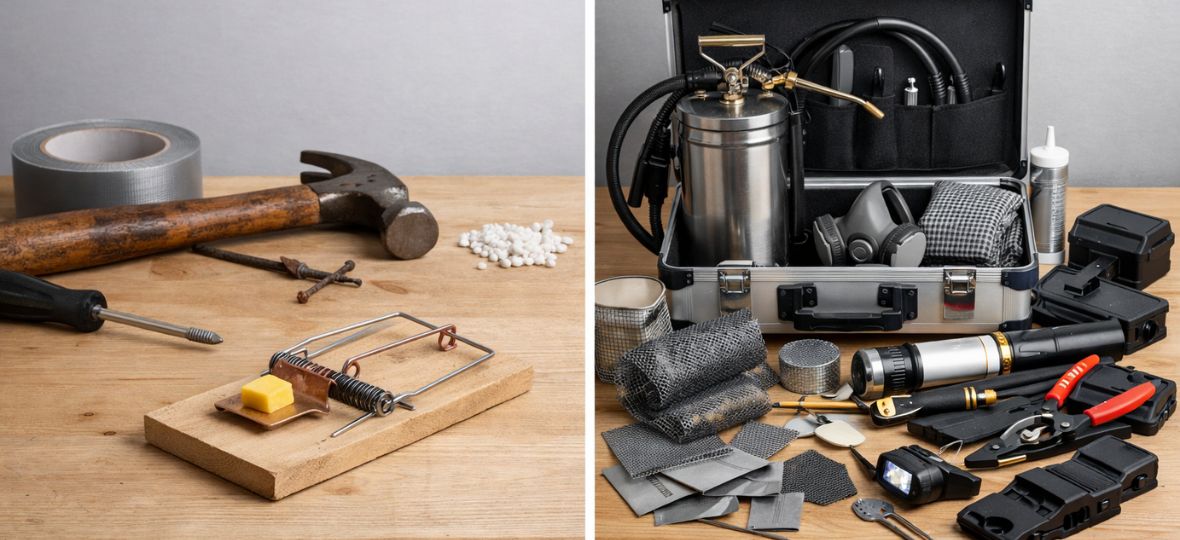
The honest answer to the DIY-versus-pro question in Winston-Salem rodent control is that it depends entirely on species, severity, and location. A single house mouse entering through a known gap in a newer Clemmons subdivision is a DIY-right situation. A roof rat colony colonizing an attic in Buena Vista. Or a Norway rat population spreading from the Old Salem sewer zone into a West Salem crawl space. Are not, not because homeowners are incapable, but because the tools, the access. And the species-specific knowledge needed make DIY ways reliably unsuccessful in those contexts.
When DIY Is Right
A single or small many mice in a modern home with a known entry point
If you found one or two droppings under the kitchen sink, found the gap around the supply line as the entry point, and your home is post-1980 construction, this is a DIY-manageable situation. A Victor snap trap baited with peanut butter, placed perpendicular to the wall with the trigger toward the wall, catches the individual mice using that runway within a few days. Follow with a 1/4-inch hardware-cloth insert around the supply line and siliconized caulk. Done correctly, this resolves a light isolated infestation.
A single mouse sighting in a garage or outbuilding
Field mice that enter garages or outbuildings in fall are common across Forsyth County and the nearby counties. A snap-trap array (three to four traps) along the wall-base runways of the garage, combined with removing accessible food sources (pet food in sealed containers, birdseed in galvanized cans), is the right DIY response to what is likely a small-number isolated situation.
Any roof rat situation
Roof rat work in Reynolda Park, Buena Vista, Mount Tabor, or Forest Hills includes attic access, species-specific snap-trap placement in rafter-level runway positions, roofline exclusion needing ladder access to soffit and gable-vent locations, and tree-access review. The physical access alone, a full attic inspection on a 1930s home with variable clearance, followed by ladder work on a two-story roofline, is a safety and expertise problem that makes DIY inadvisable for most homeowners.
Any Norway rat situation with sewer-adjacent system
Norway rats entering from the Old Salem sewer zone need exterior perimeter bait-station setup using NC-compliant tamper-resistant stations with regulated rodenticide. These stations are not available at hardware stores. They are regulated under NC structural pest control board needs. Foundation exclusion for Norway rat entry points, mortar repair, hardware-cloth setup, utility-sleeve closure, needs the tools and materials that are not standard homeowner inventory.
Set up mouse infestations in pre-1970s housing
An Ardmore bungalow with 20 to 30 entry points and a mouse population of 15 to 40 individuals is not a single-trap situation. Good treatment needs a multi-station trap array calibrated to all the active runways in the property, combined with systematic sealing of all found entry points to sub-1/4-inch tolerance. The inspection needed to map those runways and entry points, and the systematic sealing of that many gaps in original 1920s construction, is beyond what an afternoon with a caulk gun makes.
Any situation where you have droppings in multiple rooms, scratching from multiple walls, or visible gnaw damage on structural pieces
Multiple-room evidence shows an older population using multiple runways across the property, the signature of an infestation, not an isolated incident. Set up infestations need treatment programs, not spot responses.
What Hardware-Store Products Do and Don't Do
Victor snap traps are an excellent tool, the same basic mechanism pro programs use, available at Lowe's for $1.50 each. They work when placed correctly (perpendicular to the wall, trigger toward the wall. In the protected runway positions mice really use). In enough amount for the infestation size (not one trap per room, four to eight per active runway). And when the entry points are sealed so new animals don't replace the ones caught. The trap itself is not the limitation. The inspection skill to find all the runways and the exclusion work to seal all the entries is where hardware-store programs fall short.
Expanding foam, steel wool, and caulk are useful exclusion materials with real limitations. Foam is not gnaw-resistant, mice and rats will chew through it. Steel wool compresses and rusts over time, in the end losing its how well it works. These materials are right as supplements to metal mesh inserts, not as standalone exclusion methods. A gap sealed with steel wool alone is a sealed gap for about one winter.
The free inspection as a decision tool: If you are unsure whether your situation is DIY-right, the free inspection answers that question without committing you to anything. We map the evidence, find the species, check the severity, and tell you whether it is something a homeowner with a Saturday afternoon can handle or whether it needs a treatment program. You can use that info but you want, including deciding to handle it yourself with the inspection findings as a guide.
Questions About Your Winston-Salem Property?
Free inspection. Written quote. Open 24/7 across Forsyth County.