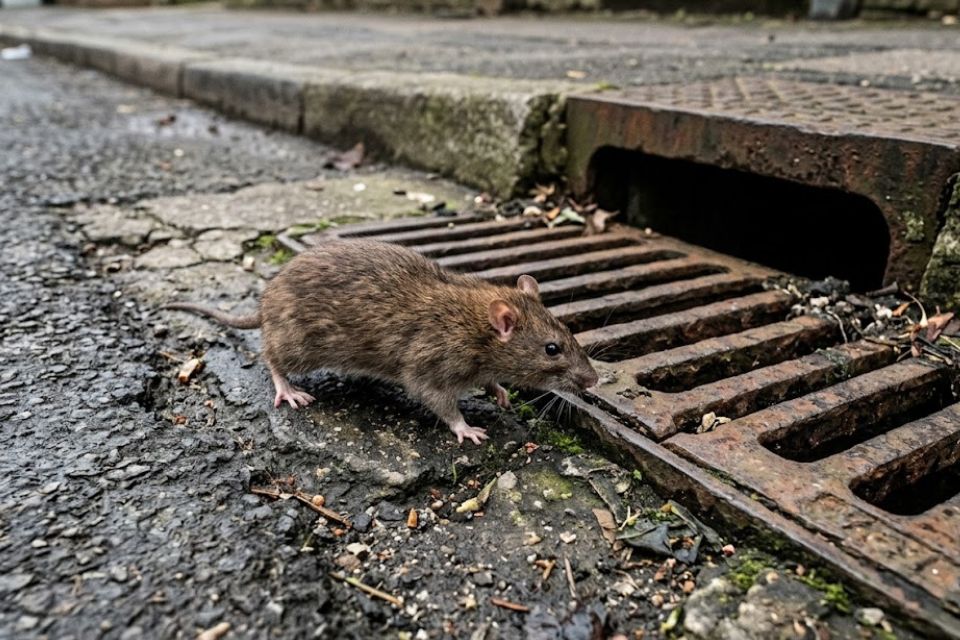
Norway rat control is species-specific work on Rattus norvegicus, the common brown rat. We get them out of below-grade and ground-level shelter. Basements. Crawl spaces. Foundation perimeters. In Winston-Salem, Norway rats concentrate in the city's oldest neighborhoods. Old Salem. West Salem. Southside. The downtown commercial corridor. The aging sewer system gives the population base that pushes rats outward into residential properties in late winter.

Norway rats are below-grade specialists. Basements. Foundation perimeters. Sewer-line proximity. They dig burrows 2 to 4 feet long with many exits. Winston-Salem's oldest sewer lines run beneath the downtown commercial corridor, Old Salem, West Salem, and Southside. Properties within 500 feet of the original brick-lined sewer trunks face Norway rat pressure on their own. The trash habits of any single property don't change that.
A Southside (27101) homeowner had burrow evidence at the foundation and rat sightings in the basement. We mapped 4 active burrows along the property perimeter, installed 6 tamper-resistant exterior bait stations on a 30-day rotation, and the population was cleared in 5 weeks. Quarterly monitoring continues. Scope: $720 setup + $180/quarter.
Norway rats are burrowers and ground-level animals. They don't climb trees or enter from rooflines, they move through soil, along utility trenches, and through foundation gaps at or below grade. In Winston-Salem, that means their population base is directly tied to the age and condition of the sewer system.
Old Salem, West Salem, and the downtown corridor sit over Forsyth County's oldest sewer mains. Some is original nineteenth-century brick-lined work. Some is early-twentieth-century clay pipe. All of it has the joint gaps and wear that give Norway rat shelter. When sewer-line population pressure builds in January and February, rats move outward through utility trenches and enter residential and commercial properties at the foundation line.
The typical Norway rat entry profile in Winston-Salem's historic neighborhoods: a brick-pier foundation with failing mortar joints wide enough to admit a rat, any gap over 1/2 inch. A crawl-space access panel without a rodent-proof perimeter seal. A utility sleeve around water or gas line that was never backfilled against rodent entry. A sump-pump discharge line that creates a soil disturbance trail from the foundation perimeter inward.
Norway rats are also the species responsible for structural burrow damage. A colony that has set up under a concrete porch slab or in a crawl-space perimeter can undermine the supporting soil over two or three seasons, a slow-motion foundation problem that doesn't announce itself until the damage is visible. Finding and treating it early matters.
| Norway Rat, Winston-Salem Profile | Detail |
|---|---|
| Species | Rattus norvegicus (brown rat, sewer rat) |
| Body size | 7–10 inches, 12–18 oz |
| Tail | Shorter than body |
| Dropping | 3/4 inch, blunt-ended at both ends |
| Habitat | Basement, crawl space, foundation perimeter, sewer-adjacent burrows |
| Entry method | Foundation gaps, utility sleeves, crawl-space vents, all at or below grade |
| Min. entry gap | 1/2 inch (quarter diameter) |
| WS hotspots | Old Salem, West Salem, Southside, Downtown, West End |
| Peak season | Year-round; Jan–Mar surge from sewer-pressure dispersal |
| Key damage | Structural burrows, foundation undermining, PVC gnawing, wiring |
A 3–4 inch diameter hole in the soil near a foundation wall, porch skirt, or wood-pile is a Norway rat burrow entrance. A single entrance usually connects to 3–6 feet of tunnel with multiple chambers. The population using it is rarely just one rat.
Exterior perimeter walk mapping all burrow entrances, foundation gaps, utility sleeve penetrations, and crawl-space vent conditions. Interior crawl-space or basement walk for droppings spread and runway mapping. Written findings.
Tamper-resistant bait stations go at burrow entrances. Also along the foundation perimeter. Spacing is set to match rat runway density. The bait is NC-compliant rodenticide. We place it per structural pest control rules. The stations are pet- and child-resistant by design.
Snap-trap arrays in basement or crawl-space runway positions, along wall bases, near utility penetrations, and at crawl-space access points. Traps placed in protected positions inaccessible to pets and children.
We physically seal all confirmed entry points at and below grade. Mortar repair at brick-pier joints. Hardware-cloth setup at crawl-space vents. Metal-flashing closure at utility sleeves. Concrete patching around sump-pump discharge penetrations.
Return visit to check bait take and trap catches, confirm knockdown, check exclusion integrity, and replenish bait stations as needed. Included on every job. Most Norway rat programs reach resolution in 2–4 weeks.
| Service | Typical Range | Notes |
|---|---|---|
| Free Inspection | $0 | Exterior + interior + burrow mapping. Written report. |
| Norway Rat Treatment | $350–$700 | Exterior bait stations + interior snap traps + one follow-up |
| Foundation Exclusion | $500–$1,500 | Mortar repair, hardware cloth, utility-sleeve sealing, vent replacement |
| Full Program (treat + exclude) | $800–$2,000 | Treatment + foundation-grade exclusion + check visit |
| Old Salem / Historic homes | Upper range | Tricky brick-pier and stone-sill geometry adds time and material |
Older masonry properties in Old Salem and West Salem with tricky crawl-space sill geometry consistently need more material and labor than newer construction. Free inspection always. Written quote before any work.
Free inspection. Open 24/7. Same-day available. Written quote before work begins.
Norway rat infestations are excluded from standard homeowner policies. Secondary damage — gnawed plumbing, electrical, structural — may qualify under sudden-accidental clauses with recorded evidence.
Call (844) 635-0403 for a free property inspection.
Modern poured-concrete foundations get standard exclusion methods. Lower cost. Brick-pier foundations need more careful work. You see those in pre-1940 Ardmore, West End, Old Salem, and parts of Boston Thurmond. We use lime-mortar-compatible methods. 20 to 40 percent premium. Stone or hand-laid foundations on historic properties cost the most. Preservation-grade materials are needed. Basement-equipped properties add interior-side exclusion that crawl-space-only properties don't need.
Properties on older blocks near aged sewer system (downtown corridor, West Salem, parts of Old Salem) often have Norway rat pressure tied to below-grade utility entry points. Treatment needs finding and sealing any sewer-line or utility-chase connection between municipal system and the property. The check work itself adds cost. The sealing materials are standard.
Light Norway rat activity (occasional droppings, single source population): 2-3 week program, lower cost. Set up population with multiple breeding sites or persistent re-entry pressure: 4-6 week program with more bait station setup, higher cost. Heavy infestations or properties with steady external pressure (commercial-adjacent, near outdoor dumpsters): may run 6-8 weeks.
Standalone Norway rat control: lowest cost. Bundled with crawl-space cleanup and contamination cleanup: higher cost but arranged workflow. Bundled with foundation moisture cleanup through a separate contractor: we arrange scheduling but the moisture work invoices separately.
Limited treatment with basic exclusion: $320-$580. Full residential Norway rat program with complete foundation exclusion: $850-$2,200. Historic-property or set up-infestation programs: $1,800-$4,200. Commercial Norway rat control prices separately by facility scope. Free inspection makes the written quote.
These neighborhoods sit over the oldest sewer system in Forsyth County. Norway rats follow utility trenches outward from main sewer lines when population pressure builds, usually January through March. The brick-pier foundations, hand-laid stone crawl-space sills, and basement-equipped masonry housing in these neighborhoods offer multiple entry paths at and below grade.
Norway rats are ground-level animals. They enter through foundation gaps, crawl-space vents, and below-grade utility penetrations, never from tree access. Treatment focuses on exterior perimeter bait stations, interior snap traps in basement and crawl-space runways, and foundation-grade exclusion sealing. Roof-rat attic treatment methods are no good for Norway rats.
Blunt-ended droppings 3/4 inch long in basement, crawl space, or along foundation exterior. Burrow holes 3–4 inches in diameter near foundation walls, utility entry points, or debris piles. Gnaw marks on structural lumber, PVC, and conduit at grade level or below. Grease rub marks along wall-base runways in basement or utility areas.
A modest Norway rat infestation in a single-family Forsyth County home usually reaches knockdown within 2–3 weeks of treatment. Foundation exclusion is usually done simultaneously. Follow-up visit included. Larger infestations tied to active sewer-line activity may take 4–6 weeks and may need planning with the city public works department about the underlying system condition.
Yes, especially in West End and Forest Hills properties that have both older below-grade foundations (Norway rat territory) and mature canopy overhead (roof rat territory). A mixed infestation needs a two-protocol way: ground-level bait stations and crawl-space trapping for Norway rats simultaneously with attic trapping and roofline exclusion for roof rats. The inspection decides which situation you have.
Year-round activity with a January-March surge as outdoor shelter temperatures drop and sewer-adjacent populations move toward warmer foundations. Late summer also brings a smaller pulse tied to outdoor food availability shifting. Norway rats remain present in low numbers through summer. They don't migrate seasonally the way some species do.
Yes, and it's more common than homeowners expect. Older Winston-Salem sewer system, especially in West Salem, Old Salem, and parts of the downtown corridor, has joints. Abandoned service connections, and floor-drain access points that Norway rats use as travel routes. A property with persistent Norway rat activity often has a below-grade entry that surface-level inspection misses.
Not modern poured concrete. They can exploit cracks, expansion joints, and degraded mortar in old concrete or stone foundations. Brick-pier foundations from the pre-1940s era are the most common Winston-Salem foundation type where Norway rats gain entry, the lime mortar between bricks softens over decades and creates openings the rats enlarge.
Norway rats carry leptospirosis, salmonella, and rat-bite fever as recorded disease vectors. Pet-on-rat contact is rare but does happen with outdoor dogs. The bigger risk for most households is contamination, droppings, urine, and chewed material in food storage and HVAC duct work. Treatment scope includes contamination cleanup where warranted.